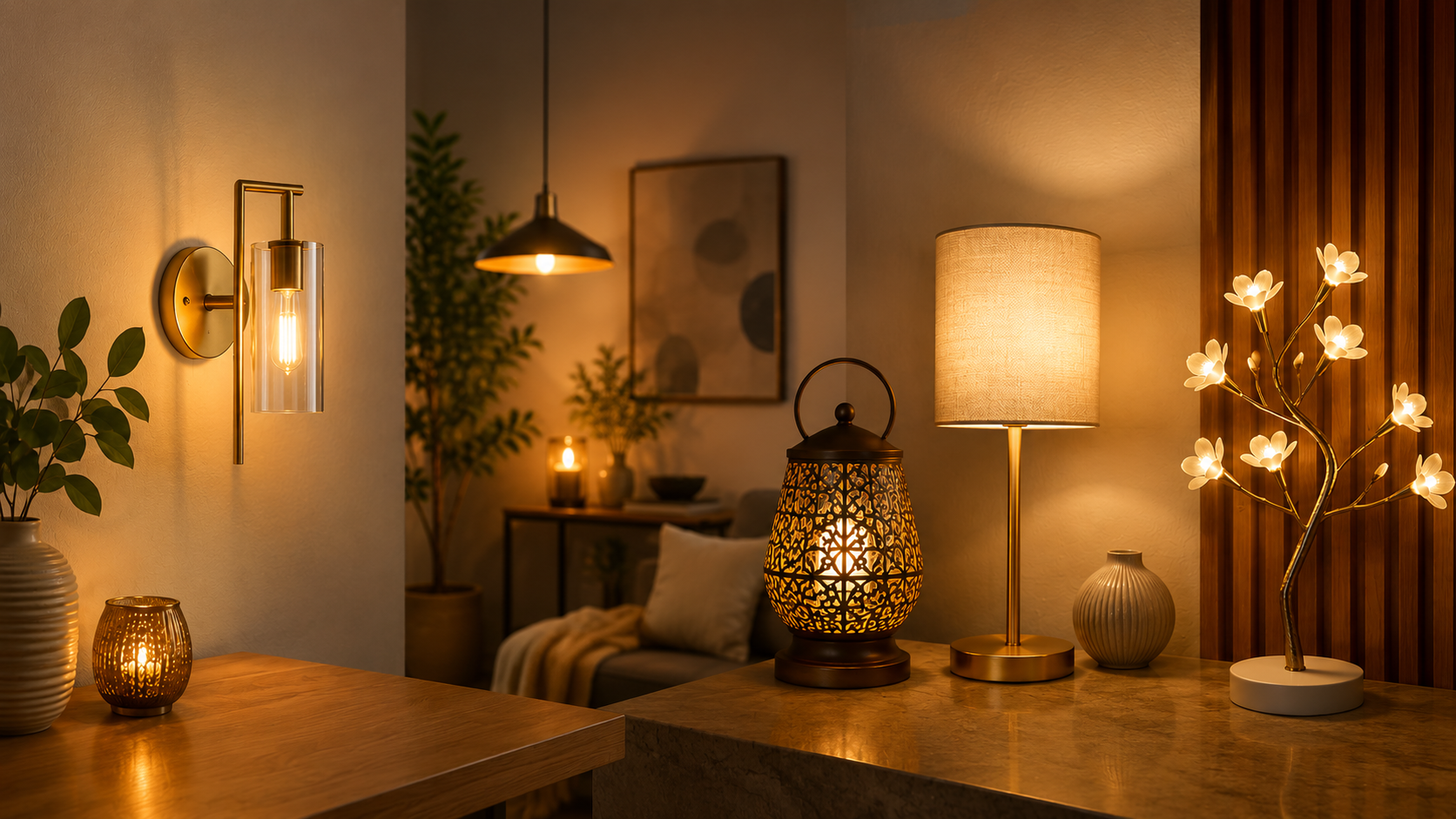


Walk into any beautifully designed home, and you'll notice something immediately: the lighting feels right. It's warm without being dim. It's bright without being harsh. It draws your eye to artwork, makes the kitchen feel inviting, and helps you relax in the bedroom. Now walk into a home with poor lighting — and you'll feel it just as quickly. The space feels flat, uninviting, perhaps even uncomfortable.
Here's the truth that most homeowners discover too late: lighting is not an afterthought. It is the foundation of great interior design.
Whether you're building a new home, renovating, or simply looking to refresh your space, this comprehensive home lighting guide will walk you through everything you need to know. From understanding the three essential types of lighting to choosing the right fixtures for every room, we'll cover it all — with expert tips, practical advice, and design inspiration along the way.
At Nooriva Light, we believe that exceptional lighting transforms houses into homes. Our curated collection of modern lighting fixtures is designed to help you achieve the perfect balance of function and beauty in every room. Let's shed some light on the subject.
Lighting is often called the "fifth wall" of interior design — and for good reason. It has the power to completely transform how a space looks, feels, and functions.
Good lighting can:
Make a small room feel larger and more open
Highlight architectural features and artwork
Improve productivity and reduce eye strain
Support your natural sleep-wake cycle
Create atmosphere and set the mood
Increase the perceived value of your home
Poor lighting, on the other hand, can:
Make even the most beautiful furnishings look dull
Create shadows that age faces and make spaces feel smaller
Cause eye strain, headaches, and fatigue
Make a home feel cold, unwelcoming, or dated
Light doesn't just decide how a house looks — it decides how it feels. The most common lighting failure in homes is single-source lighting: one ceiling fixture per room, centered, producing a flat wash of light that creates no visual depth or hierarchy. The result is functional in the most basic sense and unsatisfying in every other. No single light source can do everything. That's why professional designers never stop at one.
Expert Tip: The key to creating exceptional lighting is to develop a mix that can shift from bright and functional to soft and flattering. This is where dimming controls and multiple sources at different heights become essential.
Every well-lit room relies on a combination of three distinct types of lighting. Understanding these is the first step to mastering your home lighting plan.
Ambient lighting is the base layer — the general, diffuse illumination that makes a space usable at a basic level. It provides enough light to move through a room, orient yourself, and conduct everyday activities without strain.
Defining characteristic: Ambient light is non-directional. It fills the room rather than targeting any specific surface.
Common ambient sources:
Ceiling fixtures (flush mounts, semi-flush mounts)
Recessed downlights
Cove lighting that bounces off ceilings
Wall sconces used to wash vertical surfaces
Chandeliers and pendants
Critical insight: Ambient light should not be the brightest layer in a finished room. Its role is foundational, not dominant. When ambient light is too high, it flattens the room by eliminating the contrast that task and accent sources create.
Task lighting is the functional layer. It delivers concentrated, higher-intensity illumination to a specific zone where a specific activity takes place.
Common task lighting sources:
Under-cabinet lights in kitchens
Desk lamps in home offices
Bedside reading lamps
Vanity lights in bathrooms
Pendant lights over kitchen islands
Swing-arm lamps
Critical insight: Task lighting is always intentionally directional. It solves a specific visual problem for a specific person at a specific location. The most common task lighting mistake is substituting more ambient light for missing task light — increasing ceiling brightness does not solve a shadow on a work surface.
Accent lighting is the layer that creates visual interest, spatial depth, and hierarchy. Its purpose is to direct attention — to make one surface, object, or architectural element visually prominent.
Common accent lighting sources:
Picture lights over artwork
In-cabinet lighting
Toe-kick lights
Track lighting
Wall-wash fixtures
Critical insight: Accent light works through contrast. When a painting is lit at three to five times the ambient level around it, the eye goes there first. Without accent lighting, a space may be functional but it is visually flat.
Layered lighting is the practice of combining ambient, task, and accent sources so they can work together or independently to support different activities and atmospheres. Layered, human-centric lighting remains the gold standard: a mix of ambient, task and accent light that shifts with mood and time of day.
| Lighting Type | Purpose | Brightness Level | Common Fixtures |
|---|---|---|---|
| Ambient | General illumination | Base level (lowest) | Ceiling fixtures, recessed lights, chandeliers |
| Task | Focused activity lighting | High (targeted) | Desk lamps, under-cabinet lights, pendants |
| Accent | Visual interest & depth | 3-5x ambient | Picture lights, track lights, in-cabinet lights |
The living room is the heart of the home — a space for relaxing, reading, working, entertaining, and everything in between. It needs to be many things to many people, and your lighting should reflect that versatility.
Ambient: Start with a ceiling fixture — a chandelier, flush mount, or recessed lighting — to provide general illumination. Designers recommend roughly five to seven light sources in a main living space, spread across different heights.
Task: Add floor lamps next to sofas and reading chairs. Swing-arm or articulated lamps are particularly versatile, allowing you to move light exactly where you need it. Aim for at least 450 lumens for comfortable reading.
Accent: Use table lamps, picture lights, and wall sconces to create depth and highlight artwork, architectural features, or textured walls.
Don't rely on just one light source. A single ceiling light may brighten the room, but it often makes it feel flat and uninviting. True living quality emerges only when light comes from different directions and serves different purposes.
Place light deliberately. Light does not need to be equally bright everywhere. On the contrary: uniform illumination removes tension from a space. Different brightness levels create orientation and make the living room feel larger and more structured.
Embrace indirect lighting. Light that bounces off walls and ceilings creates spaces that feel calmer, softer, and significantly more pleasant. It avoids glare, creates no harsh shadows, and supports an even, balanced mood.
2026 trend alert: Designers are moving away from perfectly matched sets and embracing mismatched lighting pieces for added character and personality. The key to making it work? Keep one element consistent — such as the tone or material — throughout the room.
Nooriva Light Recommendation: Explore our collection of modern floor lamps and statement pendants to create the perfect layered living room lighting scheme. From sculptural designs to warm metallic finishes, we have fixtures that serve as both light sources and works of art.
The kitchen is one of the most functionally demanding spaces in any home. It's where you chop vegetables, read recipes, entertain guests, and gather with family. Good kitchen lighting isn't a luxury — it's a necessity for safety and efficiency.
Ambient: Provide general overhead illumination with flush mounts, semi-flush mounts, or recessed lighting grids. Aim for roughly 100 to 150 lumens per square foot.
Task: This is where kitchens truly come alive. Under-cabinet lighting is essential for prep areas — LED strips or puck lights should offer 350 to 500 lumens per linear foot and be mounted close to the front of the cabinet to reduce shadows.
Pendant lights over islands provide focused illumination for meal prep, dining, and homework. Hang pendants 30 to 36 inches above the countertop and space them 24 to 30 inches apart. For a standard 42-inch-wide island, fixtures around 10 to 14 inches in diameter work well, with 800 to 1,200 lumens per pendant.
Accent: Highlight architectural features, cabinetry, or decor with in-cabinet lighting, toe-kick lights, or cove lighting.
Follow the "Rule of Three." Every kitchen needs ambient, task, and accent lighting. This combination creates depth, warmth, and functionality within a kitchen.
Add a decorative layer. Every kitchen needs three essential layers of lighting: ambient, task, and accent. But adding a decorative layer — such as a statement pendant or sculptural fixture — brings personality to the space.
Consider color temperature. A color temperature of 3,000 to 4,000K ensures accurate food presentation while keeping the space warm and inviting.
Nooriva Light Recommendation: Our kitchen pendant lights combine style and function, providing the perfect task lighting over islands and breakfast bars. Pair with under-cabinet LED strips for a complete kitchen lighting solution.
The dining room is where memories are made — holiday dinners, birthday celebrations, and intimate gatherings. Your lighting should create an atmosphere that's warm, inviting, and flattering.
Ambient: A chandelier or pendant light centered over the dining table provides both ambient illumination and a focal point.
Task: While not traditionally associated with task lighting, consider adding dimmable sconces or a buffet lamp for serving areas.
Accent: Use picture lights to highlight artwork or a decorative mirror. Consider adding a dimmer switch — the single most important feature for dining room lighting, allowing you to go from bright and functional to soft and romantic with a simple twist.
Hang your chandelier at the right height. The bottom of the fixture should hang 30 to 36 inches above the tabletop for an 8-foot ceiling. For higher ceilings, add 3 inches for each additional foot of ceiling height.
Choose the right size. A good rule of thumb: the chandelier's diameter should be roughly half to two-thirds the width of your dining table.
Warm light is essential. Stick to 2700K to 3000K for a warm, flattering glow that makes food look appetizing and guests look their best.
Nooriva Light Recommendation: Our collection of dining room chandeliers and pendants features everything from sleek modern designs to timeless classics, all crafted to become the centerpiece of your dining space.
The bedroom is your sanctuary — a place for rest, relaxation, and rejuvenation. Your lighting should support these goals while also providing functionality for reading, dressing, and other activities.
Ambient: Ceiling-mounted fixtures provide general illumination. Aim for roughly 10 to 20 lumens per square foot — enough brightness for everyday activities without feeling harsh or clinical.
Task: Bedside lamps are essential for reading. Table lamps on nightstands, wall-mounted swing-arm lamps, or pendant lights hung on each side of the bed all work well. Warm white bulbs (around 2700K) are ideal for bedrooms — they create a softer, yellow-toned light that feels relaxing, especially in the evenings.
Accent: Add subtle accent lighting to highlight artwork, architectural features, or shelving. A well-designed layered lighting bedroom setup thoughtfully combines general illumination, focused task lighting, and subtle accent lighting.
Don't rely on a single overhead fixture. A bedroom with only a ceiling light is flat and uninspiring. Calm is created through light layers, not a single luminaire.
Indirect light is the foundation of relaxation. Direct light activates. Indirect light calms. Consider cove lighting, behind-headboard lighting, or lamps with fabric or frosted glass shades to soften the light.
Install dimmers. Bedrooms benefit tremendously from dimmers because they allow one light to perform multiple roles — bright in the morning, soft in the evening.
Color temperature shapes your rhythm. Warm light in the evening supports your natural sleep-wake cycle.
Nooriva Light Recommendation: Browse our bedroom lighting collection for bedside lamps, ceiling fixtures, and wall sconces designed to create the perfect restful atmosphere.
Bathroom lighting needs to be both functional and flattering. Poor lighting here can make grooming difficult and create unflattering shadows that age you by years.
Ambient: Ceiling-mounted fixtures or recessed lights provide general illumination for the entire space.
Task: Vanity lighting is critical. The best setup is ambient overhead lighting plus mirror lighting that hits your face evenly from both sides. Wall sconces mounted on either side of the mirror at eye level eliminate shadows — far superior to a single light bar above the mirror, which casts shadows downward across your face.
Accent: Use strategically placed spotlights or strip lights to highlight tilework, a stylish basin, or other design features.
Layer your light. A well-designed bathroom uses three layers of lighting to ensure both function and mood are covered.
Consider dimmers. A dimmer allows you to transition from bright, functional morning lighting to soft, spa-like evening illumination.
Safety first. Avoid installing switches or outlets within 60 to 100 cm of all sides of a bathtub or shower.
Nooriva Light Recommendation: Our bathroom lighting collection includes elegant vanity lights and wall sconces that provide flattering, shadow-free illumination for your daily routine.
With more people working from home than ever before, good home office lighting has become essential for productivity, focus, and eye health.
Ambient: Overhead ambient light provides general brightness for the room.
Task: A desk lamp delivers focused task lighting for reading or computer work. The best desk lamps are adjustable, dimmable, and directional, so you can guide the light where you need it and keep it away from your monitor.
Accent: Soft ambient light behind the monitor or on a shelf reduces contrast and eye strain. Consider adding a small key light angled slightly to one side to avoid glare.
Avoid high contrast around your screen. Harsh lighting behind your monitor can cause eye strain and fatigue.
Position your desk thoughtfully. Natural light in front of you is flattering. If you work after dark, add task lighting that's directional and glare-free.
Think in layers. Give yourself three sources: a task lamp on the desk, soft ambient light behind the monitor, and a touch of natural light if you have it.
Nooriva Light Recommendation: Our task lighting collection features adjustable desk lamps and floor lamps designed to reduce eye strain and boost productivity. Explore our range of modern home office lighting solutions.
Hallways are often overlooked in lighting plans, but they're the first and last spaces people experience in your home. Good hallway lighting creates a sense of arrival, guides movement, and ensures safety.
Ambient: Ceiling lights provide the foundation. For long hallways, consider a linear lighting approach along the length of the space — the light follows the movement through the hallway and reinforces the architectural direction.
Task: Task lighting near stairs is essential for safety and clarity, especially in low light.
Accent: Wall sconces, picture lights, or LED strips can highlight artwork, textured walls, or architectural details, adding depth and visual interest.
Layer at three heights. Designers recommend building in three layers of lighting, at the top, middle, and bottom of the hallway.
Break the tunnel effect. Vertical wall sconces or sequences of adjustable spotlights can make a long, narrow hallway feel wider and more inviting.
Use mirrors strategically. A large mirror positioned opposite a light source can double the amount of light in the hallway.
Nooriva Light Recommendation: Discover our collection of hallway lighting — from elegant wall sconces to modern flush mounts — designed to make every entry and transition in your home feel warm and welcoming.
Outdoor lighting enhances curb appeal, improves safety, and extends your living space into the evening hours. Every great outdoor lighting design follows three essential goals: safety, function, and atmosphere.
Safety: Illuminate walking paths, stairs, driveways, and entryways clearly.
Function: Provide adequate light for outdoor activities — dining, entertaining, gardening — after dark.
Atmosphere: Use accent lighting to highlight garden features, architectural details, and create a warm, inviting ambiance.
Start by identifying key features. Then layer light to create depth, focusing on vertical surfaces and minimizing glare.
Consider materials. Weather — especially humidity, salt air, and sunlight — shapes which materials and fixtures will best stand the test of time.
Choose warm light. Warmer outdoor lighting (2700K–3000K) is more inviting and more responsible for preserving night skies.
Nooriva Light Recommendation: Explore our outdoor lighting collection for stylish, durable fixtures that enhance your home's exterior while providing safety and ambiance.
Color temperature, measured in Kelvin (K), describes the appearance of the light a bulb produces. Lower Kelvin values produce warmer, more amber light. Higher Kelvin values produce cooler, more blue light.
| Color Temperature | Appearance | Best For |
|---|---|---|
| 2200K–2700K | Warm, amber glow | Bedrooms, living rooms, dining rooms |
| 2700K–3000K | Warm white | Most residential spaces |
| 3000K–3500K | Soft white | Kitchens, bathrooms |
| 3500K–4100K | Neutral white | Home offices, task lighting |
| 4100K–5000K | Cool white | Garages, workshops (use sparingly at home) |
| 5000K–6500K | Daylight | Hospitals, industrial (avoid in homes) |
Warm light (2700K–3000K) is ideal for most living spaces. It creates a cozy, inviting atmosphere and is flattering to skin tones. Avoid cool white light bulbs, which emit a more clinical, cold light.
Neutral light (3000K–4000K) works well in kitchens and bathrooms where accurate color rendering is important for food prep and grooming.
The 2026 trend: Designers are embracing tunable white lighting that can shift color temperature throughout the day to support natural circadian rhythms.
Expert Tip: When in doubt, choose warmer light. You can always add a cooler task light for specific activities, but warm ambient light is almost always more inviting.
Lumens measure the amount of light produced by a light source. Watts measure energy consumption — they are not a reliable indicator of brightness.
| Room | Recommended Lumens |
|---|---|
| Living Room (ambient) | 1,500–3,000 total |
| Living Room (reading) | 450+ per reading spot |
| Kitchen (ambient) | 100–150 per sq ft |
| Kitchen (task) | 300–500 per linear foot |
| Bedroom (ambient) | 10–20 per sq ft |
| Bathroom (vanity) | 700–800 per sq meter |
| Home Office (task) | 450–800+ |
A standard 100W incandescent bulb produces around 1,600 lumens. But LED technology is far more efficient. Current LEDs typically deliver 100–180+ lumens per watt, compared to 50–100 lumens per watt for traditional technologies.
This means a 12W LED bulb can produce the same brightness as a 90W incandescent bulb. When shopping for bulbs, always look at lumens, not watts.
Expert Tip: For good general lighting in most homes, aim for around 1,000–2,000 lumens for ambient lighting and 400–600 lumens for accent lighting.
Selecting the right fixtures is about more than just aesthetics. The right fixture can make or break your lighting plan.
Scale and proportion. Before you shop, look at your floor plan and ceiling heights — that's the volume of space you're trying to light. A fixture that's too small will look lost; one that's too large will overwhelm the space.
Function. Knowing what space you want to light will help you select the right fixture type — ambient, accent, or task lighting.
Finish. Consider the piece's finish and how it complements your existing decor. Warm metal finishes such as aged brass continue to lead lighting trends in 2026.
Timelessness. Look for unique silhouettes that don't feel trendy — pieces you'll love for years.
Room height. Track lighting may need taller ceilings, while low ceilings benefit from recessed or flush-mount lighting.
Sculptural lighting is defining spaces — clients are thinking about lighting less as a utility and more as a sculptural statement. Decorative lighting acts as a piece of sculpture for the room.
Textured surfaces are making a strong comeback — ribbed glass, perforated metal, etched surfaces, and woven materials all change how light is experienced.
Organic shapes create movement and flow, moving away from forms that feel strict or static.
Nooriva Light Recommendation: Our curated collection features on-trend designs that are also timeless — sculptural pendants, warm metal finishes, and organic shapes that will elevate your home for years to come.
Lighting accounts for a significant portion of home energy use. With a few smart choices, you can reduce your energy consumption and save money without sacrificing style or comfort.
Switch to LED. LED bulbs consume up to 75% less energy than traditional incandescent bulbs. They also last significantly longer — up to 8 times longer than halogen lamps.
Use dimmers. By reducing brightness, you reduce energy consumption. Depending on the decrease in intensity, you can save 5 to 50% in energy costs.
Maximize natural light. Open curtains and blinds during the day. Choose decor in light colors to enhance the power of your lighting.
Use task lighting. Rather than illuminating an entire room, use focused task lighting for specific activities.
Turn off lights you're not using. It sounds simple, but it's one of the most effective energy-saving measures.
Keep fixtures clean. Dust and dirt reduce lighting efficiency.
| Bulb Type | Lumens per Watt | Lifespan | Energy Use |
|---|---|---|---|
| Incandescent | 10–15 | 1,000 hours | High |
| Halogen | 15–25 | 2,000 hours | Medium-High |
| CFL | 50–70 | 8,000 hours | Medium |
| LED | 80–180+ | 25,000+ hours | Very Low |
Nooriva Light Recommendation: All Nooriva Light fixtures are designed to work with energy-efficient LED bulbs, helping you create a beautiful home while reducing your environmental footprint.
Even experienced homeowners make lighting mistakes. Here are the most common — and how to avoid them.
One of the most frequent mistakes in indoor lighting is relying on a single light source, typically an overhead fixture. This approach can result in flat, uninspiring spaces. Only overhead lighting can cause reduced visibility, glare, and a poor aesthetic with little dimension.
The fix: Layer ambient, task, and accent lighting throughout every room.
Choosing bulbs that are too cool (high Kelvin) makes spaces feel clinical and unwelcoming. Choosing bulbs that are too warm in task-oriented spaces can make it hard to see clearly.
The fix: Match color temperature to room function — warm (2700K) for living and sleeping spaces, neutral (3000K–4000K) for kitchens and bathrooms.
Choosing a fixture that's too small or too large for the space.
The fix: Measure your space and choose fixtures proportionally. A good rule of thumb: a chandelier should be roughly half to two-thirds the width of the table or space below it.
Many bedrooms lack adequate reading lights.
The fix: Every bed needs bedside lighting — table lamps, wall-mounted swing arms, or pendants.
Without dimming capability, even a well-chosen fixture can feel too intense.
The fix: Install dimmer switches in every room where you want flexibility — living rooms, dining rooms, bedrooms, and bathrooms.
Lighting is not just about seeing — it's about feeling.
The fix: View lighting as an integral part of your interior design, not an afterthought.
Overlighting is the overcorrection: as many recessed lights as the ceiling will hold, all on the same circuit, all at full brightness. The result feels like a retail environment — uniformly bright, without warmth.
The fix: Less is more. Use fewer, more thoughtfully placed fixtures with dimming controls.
Nooriva Light Insight: Every fixture in our collection is designed with both form and function in mind — so you never have to choose between beauty and performance.
The best living room lighting combines ambient (ceiling fixtures), task (floor and table lamps for reading), and accent lighting (wall sconces, picture lights) to create a flexible, inviting space.
Aim for roughly 10 to 20 lumens per square foot for ambient bedroom lighting. Add 450+ lumens per reading spot.
A color temperature of 3,000 to 4,000K ensures accurate food presentation while keeping the space warm and inviting.
Hang pendants 30 to 36 inches above the countertop.
Ambient provides general illumination. Task provides focused light for specific activities. Accent highlights features and creates visual interest.
Designers recommend five to seven light sources in a main living space, spread across different heights.
3000K is generally preferred for bathrooms — it's warm enough to be flattering while providing good visibility for grooming tasks.
Dimmers allow one light to perform multiple roles — bright for tasks, soft for relaxation — and can save 5 to 50% in energy costs.
The chandelier's diameter should be roughly half to two-thirds the width of your dining table or the space below it.
Layered lighting creates depth, flexibility, and atmosphere. A room with only ambient light is illuminated. A room with all three types of light feels designed.
Lighting is one of the most powerful tools in interior design — and one of the most overlooked. Whether you're building a new home, renovating, or simply refreshing a room, thoughtful lighting can transform how your space looks, feels, and functions.
Remember the golden rules:
Layer your light — ambient, task, and accent in every room
Choose warm color temperatures (2700K–3000K) for living spaces
Install dimmers for flexibility
Think about lumens, not watts
Choose fixtures that are both beautiful and functional
At Nooriva Light, we're passionate about helping you create a home that's beautifully lit. Our curated collection of modern lighting fixtures combines exceptional design with superior quality — so you never have to compromise between style and performance.
Ready to transform your home? Explore our full collection at noorivalight.shop and discover the perfect lighting for every room.


